Plants
History of Biophilia
The History of Biophilia: Timeline of Events
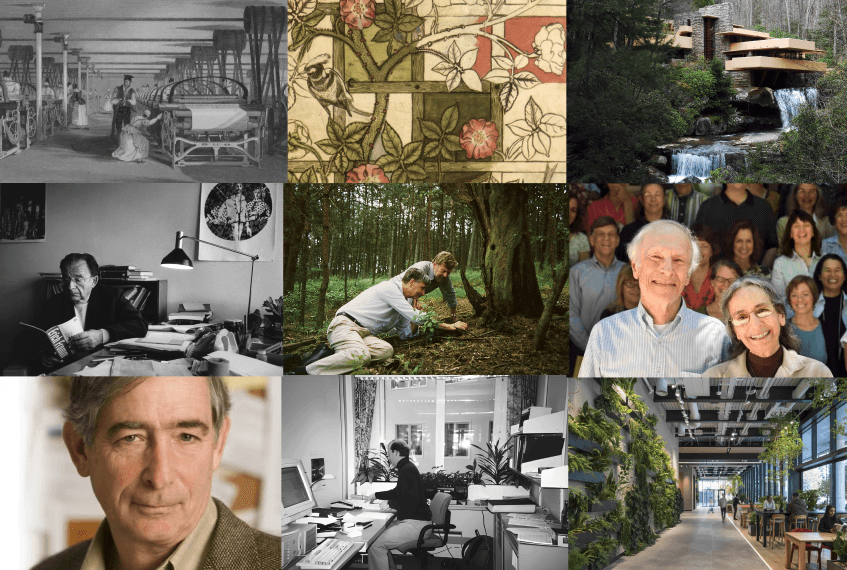
GreenHaus is an exploration of biophilia as it stands today, in this present moment. But in order to explore the present, and imagine the future, we must first acknowledge the past. Biophilia is an evolving concept that has taken many forms over the years. There have been periods of progress, and stretches of regression.
With industrialisation, our connection to nature was all but forgotten. Natural spaces became the reserve of the elite, while workers were confined to factories, drawn away from the rolling fields of rural life into the cold, hard bricks and steel of the city. So how did we find our way back? And who helped us get here? Here we take a look at the history of biophilia (in a western context), and some of its key influences.
Biophilic inspiration has been present for as long as humans have been building. From the Hanging Gardens of Babylon, an ancient cascade of greenery, to the Villa of Livia, wife of Emperor Augustus, whose home was adorned with painted natural scenes to keep her constantly surrounded by nature, history offers countless examples of our enduring desire to connect with the natural world.
Around the world, for most of history, our settlements have been entirely intertwined with the natural world, whether by design or by demand. Until the middle of the seventeenth century, we expected nature to lead in everyday life.
The Industrial Revolution: 1760 - 1840
Our modern biophilic story truly begins here. As dramatic advances in farming, production, and travel transformed daily life, attitudes toward work changed just as profoundly.
Mass migration from rural communities to cities, combined with breakthroughs in medicine, led to booming populations. The result was less space, longer hours, and a growing disconnection from the natural world. Simultaneously, the rise of lean working processes introduced by leading industrialists brought an unprecedented focus on efficiency and profit, reshaping the very way people lived and worked.
The Arts and Crafts Movement: 1880–1920
In response to industrialisation, designers and thinkers such as William Morris and John Ruskin led a return to craftsmanship, authenticity, and natural beauty. They believed that the built environment should reflect the harmony of the natural world, not its exploitation.
Their ideals introduced an ethical dimension to design, reconnecting creativity, morality, and environment. These ideas would later echo through sustainability and biophilic design philosophies.
The Modernist Era: 1920–1960
Modernism reimagined our relationship with nature through simplicity, balance, and material honesty. Architects such as Frank Lloyd Wright championed “organic architecture,” a philosophy that placed buildings in direct harmony with their surroundings.
Wright’s work blurred the boundary between internal and external, reminding the modern world that progress could coexist with nature rather than overpower it.
The Psychology of Connection: Erich Fromm, 1964
The philosophical foundations of biophilia were first articulated by Erich Fromm, a German social psychologist and humanist philosopher. He introduced the term in his book The Heart of Man, which explored the deep and complex theme of good and evil within the human collective psyche.
In it, he equated life, living, and growth with our sense of what it means to be good. Fromm described biophilia as “the passionate love of life and of all that is alive; it is the wish to further growth, whether in a person, a plant, an idea, or a social group.”
He saw biophilia as a core human orientation — an intrinsic drive toward growth, connection, and vitality across biological, social, and philosophical dimensions. Fromm’s interpretation gave the concept emotional and moral depth, setting the stage for its later scientific exploration.
Biophilia Defined: Edward O. Wilson, 1984
Two decades later, Edward O. Wilson, a Harvard biologist, brought the concept into scientific discourse with his book Biophilia (1984). In it, he proposed that humans possess an innate, evolutionary tendency to seek connections with other forms of life.
He argued that we remain guided by ancient biological mechanisms, and that our relationships with other species and wider ecosystems are deeply embedded within us.
Wilson’s work transformed biophilia from philosophy into theory, expanding its scope for scientific testing and practical application. His ideas inspired a new generation of researchers, including Stephen Kellert, who would go on to translate the principles of biophilia into the design of the built environment.
Design Meets Science: Stephen Kellert, 1990–2016
Collaborating with Wilson, Stephen Kellert, a social ecologist at Yale, became one of the leading pioneers of biophilic design.
His influential works — The Biophilia Hypothesis (1993), co-written with Edward Wilson, and Biophilic Design: The Theory, Science and Practice of Bringing Buildings to Life (2008) — drew together the growing body of research on biophilia, establishing a coherent set of core principles and identifying the measurable benefits of integrating nature into architecture.
Kellert transformed biophilia into a more structured and applicable design philosophy. He linked his concepts back to the humanistic values championed by Morris, Ruskin, and Wright.
Restorative Environments: Rachel and Stephen Kaplan, 1989–2000s
In parallel, environmental psychologists Rachel and Stephen Kaplan deepened the scientific case for nature’s restorative effects.
Their pioneering Attention Restoration Theory (ART) demonstrated how natural settings help replenish cognitive focus and reduce mental fatigue, offering tangible proof that our brains are wired to respond positively to the natural world.
Their research complemented Kellert’s findings, creating a robust psychological foundation for biophilic design.
The Rise of Evidence-Based Biophilia: 1984–2000
Comprehensive studies by Roger Ulrich and Margaret Burchett reinforced the measurable benefits of nature in built environments.
Ulrich’s “View Through a Window” study (1984) explored the benefits of planting in medical spaces. Hospital patients with views of trees recovered faster than those facing blank walls.
Around the same time, Professor Margaret Burchett and her colleagues at the University of Technology Sydney proved that indoor plants remove harmful VOCs and can improve performance in workspaces.
Throughout the nineties, Norwegian botanist Tove Fjeld conducted a range of studies exploring similar themes: the effects of planting within office, hospitality, and school settings.
Restorative Environments - Rachel and Stephen Kaplan: 1989–2000s
In parallel, environmental psychologists Rachel and Stephen Kaplan deepened the scientific case for nature’s restorative effects.
Their pioneering Attention Restoration Theory (ART) demonstrated how natural settings help replenish cognitive focus and reduce mental fatigue, offering tangible proof that our brains are wired to respond positively to the natural world.
Their research complemented Kellert’s findings, creating a robust psychological foundation for biophilic design.
The concept of biophilia is ever evolving.
Today, biophilic design is streaking ahead as a philosophy in its own right. Buildings are being designed to self-ventilate like termite mounds; London skyscrapers are being named after vegetables; and more flagship offices than ever are filling their spaces with living plants. Thanks to the groundwork laid by the pioneers we celebrate above, the scope for biophilic design is now broader and more fruitful than ever.
In this brief history, we see how, over the span of barely one hundred and fifty years, our world has shifted radically, and our relationship with nature has undergone multiple transformations in an astonishingly short time.
We live in a fast-moving world. Who can say what the next evolution of biophilia will look like? Responsive technologies? Automated plant care? Perhaps something simpler; a renewed desire to reconnect with our innate bond to the natural world. One thing is certain: our need for nature, and nature’s quiet influence on our wellbeing, is not going anywhere anytime soon.
Biophilia Now and Beyond
The concept of biophilia is ever evolving. Today, biophilic design is streaking ahead as a philosophy in its own right.
Buildings are being designed to self-ventilate like termite mounds; London skyscrapers are taking inspiration from vegetables; and more flagship offices than ever are filling their spaces with living plants.
Thanks to the groundwork laid by the pioneers we celebrate above, the scope for biophilic design is now broader and more fruitful than ever.
In this brief history, we see how, over the span of barely one hundred and fifty years, our world has shifted radically, and our relationship with nature has undergone multiple transformations in an astonishingly short time.
We live in a fast-moving world. Who can say what the next evolution of biophilia will look like? Responsive technologies? Automated plant care? Perhaps something simpler — a renewed desire to reconnect with our innate bond to the natural world.
One thing is certain: our need for nature, and nature’s quiet influence on our wellbeing, is not going anywhere anytime soon.